Do Technologies Really Make Us Happier?
By PREYOU PROJECT
Published 2026-10-28 14:45

I can't imagine my life without a smartphone. My morning begins with checking the news, and my day ends with scrolling through Instagram or TikTok. I communicate, study, and even relax online. However, I realize that behind all this convenience lie serious problems that subtly affect all of us, including me.
One of the main problems is what is known as "like addiction." Every like on a photo triggers the release of dopamine in our brains — the hormone associated with pleasure. This makes us check our phones again and again, hoping for approval. When we receive few reactions, we may feel sad or even depressed.
Social media has become a platform for constant competition: who looks better, who eats the most delicious food, and who goes on the most expensive holidays. This can lower our self-esteem and create a feeling that we're missing out on something or that our lives aren't "interesting enough." It puts enormous pressure on our mental health, especially for young people who are still trying to find their place in the world.
In addition, technology has radically changed our ability to concentrate. We've become accustomed to "fragmented thinking," where information is presented in short, attention-grabbing bursts, as on TikTok. As a result, reading a long article or watching a serious film can become a real challenge for our brains.
We are constantly distracted by notifications, making it difficult to fully immerse ourselves in work or studying. This kind of "multitasking" actually exhausts our nervous system and leads to mental fatigue.
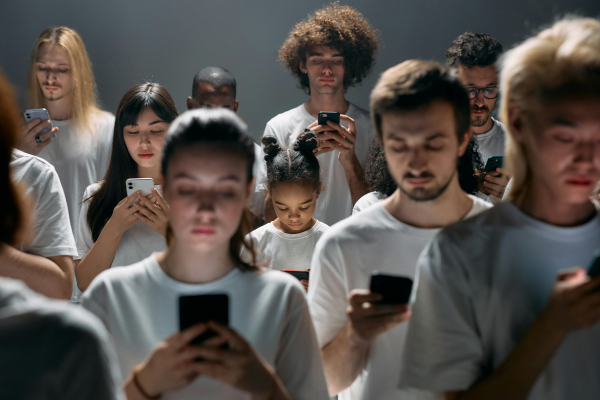
 Смартфони змінюють наше мислення. Image: Smartphones are changing the way we think. Photo: cottonbro studio / Pexels. The photo was taken from a website where photographers and studios share their work for free public use.
We shouldn't forget the physical effects, which are closely connected to our mental well-being. Using digital devices late in the evening disrupts the production of melatonin — the sleep hormone — which can make us more anxious, irritable, and less resilient to stress.
We fall asleep with our phones in our hands, and our brains don't have enough time to "reboot." Over time, this can lead to chronic fatigue.
However, technology isn't entirely bad. It opens up incredible opportunities for personal development. Today, we can learn languages, exercise using video tutorials, or find like-minded people anywhere in the world.
Social media can also help people with disabilities or those who feel lonely find communities and support. The only question is whether we control technology or technology controls us.
 Люди сидять у телефоні в кафе. Image: People using their phones in a café. Photo: silverkblack / Pexels. The photo was taken from a website where photographers and studios share their work for free public use.
To sum up, I want to point out that the human mind is quite adaptable, but it wasn't prepared for such a rapid digital transformation. Technology has an enormous impact on us, from feelings of insecurity caused by seemingly perfect images online to difficulties with concentration.
To maintain good mental health, it's important to take breaks from screens, avoid comparing our real lives with other people's virtual ones, and use digital devices when they genuinely benefit us rather than simply to kill time.
Finding a balance between the real and digital worlds is the key to peace of mind in today's fast-paced society.
This weekend, I'm planning a digital detox. I'll turn off my phone, go for a walk with my friends beneath the beautiful blooming magnolia trees, and spend the evening playing board games with my family.
I'll prove to myself that I can be happy without a smartphone. I think I can do it.
What about you?
 Людина сидить у телефоні у громадському транспорті. Image: A person using their phone on public transport. Photo: zhangkaiyv / Pexels. The photo was taken from a website where photographers and studios share their work for free public use.
References: (1) Гречановська О.В. та ін. Вплив соціальних мереж на психологічний стан та самооцінку української молоді, (2) Psyhologist.com.ua. Вплив соціальних мереж на психіку підлітка: як технології формують сучасну молодь, (3) Міністерство освіти і науки України (МОН)
Writers
As contributors to Mobile Stories, we adhere to its editorial guidelines. This involves verifying our sources, ensuring we don't violate any copyrights, and following the Young Reporter's Code of Ethics. Find out more about Mobile Stories. Read more about the Young Reporter's Code of Ethics.
 28 Oct |
 28 Oct Pupil |
 28 Oct Pupil |
 28 Oct Pupil |
 28 Oct Pupil |
 07 Sep Pupil |
 10 Jun Pupil |
 01 Jun Pupil |
 01 Jun Pupil |
 01 Jun Pupil |
 01 Jun Pupil |
 01 Jun Pupil |
 01 Jun Pupil |
 01 Jun Pupil |
 31 May Pupil |
 31 May Pupil |
|
31 May Pupil |
 31 May Pupil |
 31 May Pupil |
 31 May Pupil |
 31 May Pupil |
 31 May Pupil |
 31 May Pupil |
 31 May Pupil |
|
28 May Pupil |
|
19 May Pupil |
|
19 May Pupil |
 19 May Pupil |
 19 May Pupil |
 19 May Pupil |
 19 May Pupil |
|
28 Oct Pupil |
|
28 Oct Pupil |
|
28 Oct Pupil |
|
28 Oct Pupil |
|
28 Oct Pupil |


 22 May |
|
31 May Pupil |
|
31 May Pupil |
|
31 May Pupil |
|
31 May Pupil |
|
31 May Pupil |
|
31 May Pupil |
|
31 May Pupil |
|
31 May Pupil |
 |
 |