How FOMO affects young minds

Published 2026-05-31 19:55

FOMO, fear of missing out, is a concept that has existed forever. Some might even believe it existed during the stone age. It originates from humans’ need to feel validated and accepted. We, as teenagers, have seen an increase in FOMO because of our use of social media in our daily life. Therefore we are going to investigate how and why it affects young people, if you can cure it and, in that case, how?

What is FOMO? Many of you have surely heard of it. It stands for “Fear of Missing Out” and originated from a newspaper article Patrick McGinnis wrote for the Harvard Business School magazine in 2004. Him and his friends had a hard time choosing between activities. So, they gave their anxiety a name: FOBO, fear of a better option. But shortly after they found a better name: FOMO. It wasn’t the fact of missing out on a better option rather than missing out, out on what? What do you know, years later it’s a standard part of our vocabulary and has even made it into our dictionary. 

Most of you have probably experienced FOMO in your life. It comes with a lingering uneasy feeling that is not quite sadness or jealousy. It’s more like helpless anxiety of what you might be, or already are missing out on and there is nothing to do about it.

What is the science behind it you ask? Well, Dr. Vogel states “When we feel as if we’re part of a community and others approve of us, we feel better about ourselves. When we don’t get that sense of community approval, we feel worse about ourselves.” This roots back to our primal need to feel included. Homo sapiens are herd animals, that are drawn to each other and seek acceptance. The psychology behind it goes back to ancestral humans living in small tribes. Being excluded from the tribe didn’t just kill their “social life” but could be a survival threat. Natural selection target vulnerable individuals, like an excluded person. FOMO is basically an ancient alarm system reacting to a modern environment.

We spoke to four teenagers, two boys and two girls, at Anna Whitlocks gymnasium about their experiences with FOMO. They all had experienced fear of missing out more than once before. The girls thought that the biggest causes for FOMO for them, was when large friend groups hung out and when it seemed like everyone had plans except for them. The boys, however, experienced more FOMO from smaller gatherings such as gym sessions and said that they seldom experienced the phenomenon from larger parties.

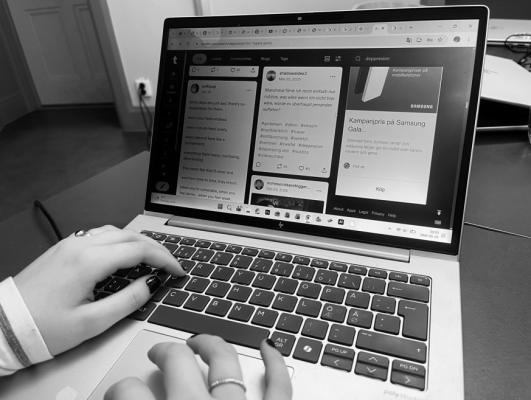
One thing both genders had in common was how social media affected their fear of missing out. Nowadays our phones seem to act as a tool for entertainment, rather than for communication. The rise of social media has led to it being perceived as essential for keeping up with the latest happenings and this of course makes it difficult for teenagers to avoid seeing posts with pictures of social gatherings they were not invited to. When asked the question “Does using social media affect your experience with fear of missing out?”, the teenagers agreed and said that it often made them feel a bit sad that they weren’t invited or included when seeing posts of how fun someone had.

We also gave the interviewees a scenario to reflect upon. “You’re exhausted after a long school day, looking forward to relaxing at home. Suddenly your friend gives you a last-minute invitation to a party. Would you go?”

The answers we got were that it depended on who invited them and where the party was going to be located, but that they would say yes in most cases. When asked about it, all of them answered that they preferred the feeling of regretting doing something, rather than regretting not doing something. Research at Purdue University shows that detecting ostracism, being excluded, is vital for animals. Therefore it’s not strange that our brains still have a bias towards over-detection of being excluded and don’t enjoy the feeling of missing out. It might have worked on the savannah, but seems more like an inconvenience for our mental health today.

We believe there are multiple ways to overcome, or at least reduce the feeling of FOMO, though they might be difficult to figure out. These are some of them:

· It’s easier said than done, but one important step is to always remember that social media is not real life and to limit your comparisons. The short glimpse of a life that you see on your feed does not represent their full reality.

· Another step to take towards reducing the feeling of FOMO, is to unfollow those who negatively affect you the most on social media. Reducing your screen time is of course optimal as well. 

· Lastly, it’s easy to forget that there are many fun activities that are not necessarily aesthetically pleasing on social media. Simple activities such as speaking to someone on the phone or going for a walk while listening to music can provide so much enrichment. Forget the things you could’ve been doing and focus on what is available for you.

To summarize, FOMO is a rarely new phenomenon that makes us question our social status. It comes from humans’ primal need to feel included and survive, though surviving now means being invited to gatherings and not missing out. FOMO gives people anxiety and the constant need to feel included, but there are steps one can take towards a FOMO-free life like remembering that social media is not real life. Now that you know what FOMO is and why we experience it, hopefully it can give you a better understanding of the phenomenon and how to deal with it.

References: (1) Fear of Missing Out, FOMO - i den digitala eran, (2) FOMO i det digitala ungdomslivet. En kvalitativ studie om synlighet, normer och digitalt välbefinnande, (3) FOMO, Fear of missing out, (4) Ostracism: The Early Detection System
Images in article: (1) , (2)
Writers
Photo
Photographer : Filippa Rosling
31 May
Pupil
Freya
31 May
Pupil
31 May
Pupil
Photo taken by me
31 May
Pupil
Amanda
31 May
Pupil
Ellen Wallin
31 May
Pupil
Photo: Elsa
31 May
Pupil
Illustration: Gustav Iggmark
31 May
Pupil
Sahara Elliston
31 May
Pupil
Vera Neovius
31 May
Pupil
19 May
Pupil
19 May
Pupil
Pixabay - Chuotanhls
19 May
Pupil
Bhavyata Nimavat/Pexel
19 May
Pupil
chatgbt
19 May
Pupil
IMAGE: Freepik
19 May
Pupil
Official steam background image
19 May
Pupil
Photo by Julio Melanda from Pexels: https://www.pexels.com/photo/variety-of-baked-and-dessert-foods-on-plates-1448721/
19 May
Pupil
Tiba Gate
08 May
Pupil
Isa Ardelean
08 May
Pupil
Unsplash
18 Apr
Pupil
https://pixabay.com/ro/users/kei_therapeutic_art-26170337/
16 Dec
Pupil
Minna Sidibe Persson
13 Oct
Pupil
pexels.com
30 Sep
Pupil
pexels.com
30 Sep
Pupil
Hannah Busing (unsplash.com)
25 Jun
Pupil
https://www.freepik.com/free-vector/isometric-garbage-flowchart-with-factory-truck-processing-sorting-pressing-containers-loading-scavenger-descriptions-illustration_15330906.htm#fromView=keyword&page=1&position=0&uuid=4a039fe5-c59d-47bd-b83c-6a02628e5485&query=Waste+Management
16 Jun
Pupil
Source: https://propolitica.ro/2024/12/05/bistrita-are-din-aceasta-seara-un-nou-consiliu-local-al-tinerilor-un-moment-care-marcheaza-inceputul-unei-noi-generatii-de-lideri-locali-a-punctat-primarul-lazany/
10 Jun
Pupil
Google
10 Jun
Pupil
06 Jun
Pupil

WORLD

Julia Hedblom
31 May
Pupil
Photographer : Filippa Rosling
31 May
Pupil
Freya
31 May
Pupil
31 May
Pupil
Photo taken by me
31 May
Pupil
chatgbt
19 May
Pupil
IMAGE: Freepik
19 May
Pupil
Official steam background image
19 May
Pupil
Photo by Julio Melanda from Pexels: https://www.pexels.com/photo/variety-of-baked-and-dessert-foods-on-plates-1448721/
19 May
Pupil
Tiba Gate
08 May
Pupil
Isa Ardelean
08 May
Pupil
Unsplash
18 Apr
Pupil
https://pixabay.com/ro/users/kei_therapeutic_art-26170337/
16 Dec
Pupil