Why we desire to be sad & how the internet makes it worse
By ANNA WHITLOCKS GYMNASIUM
Published 2026-05-31 20:50
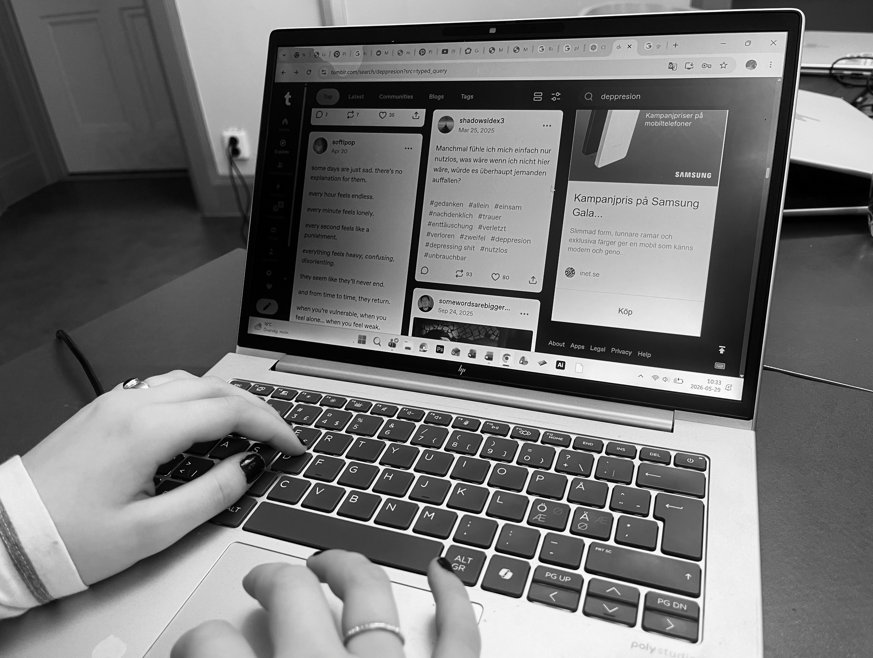
Humans have always had a strange relationship with sadness and suffering. Somehow avoiding it with all we have but also getting drawn to it at the same time. I research why that is and why this behaviour has gotten worse lately with the internet growing every day.
“In some way, suffering ceases to be suffering at the moment it finds meaning, such as the meaning of sacrifice. That is why man is even ready to suffer, on the condition, to be sure that his suffering has a meaning.” – Viktor Frankl
When I sit and scroll on social media as one does when you´re a teenager, its not unusual for me to get a blog, a post, a meme or a reel about mental illness. Sometimes it´s someone talking about their experience with depression, self-harm or suicidal thoughts. Sometimes it’s a therapist or a doctor of some sort and sometimes it’s a parent or a friend of someone who´s mentally unwell. One common element between them all that can´t go unnoticed by me is that a lot of the time most of the comments isn’t supportive or helping. But rather people talking about their own problems and minimizing them, and making them into jokes. Then a lot of people respond to those comments laughing along and almost encouraging the person who posted to continue this behaviour. It´s almost like they don’t want to get better. I even saw a chain of comments sharing ways to self-harm more effectively. It led me to ask why humas act this way, why do we desire to be sad? Is it easier? Is there a gain in feeling miserable?
Fredrich Nietzsche is a German/Prussian philosopher that discusses just this topic. He claims that we as humans weren’t born with a set of morals. We don’t punish bad people simply because our morals tell us to. He argues that this is actually an advanced concept for us to understand. It needs us to realise that an event or action wasn’t accidental but intentional and that it was the wrong kind of intentions. He says that the origin for this way of thinking comes from the contractional relationship, where every injury has an equivalent. If you hurt me, your “debt” can be repaid by me hurting you an equal amount. So instead of money or goods, people were compensated by bringing suffering onto someone else. A live example of this is the medieval public executions and torture simply for entertainment. But how does this relate to our times today?
When humanity entered into civilized society, it became morally wrong to publicly torture people, understandably. Nietzsche claims that this is where guilt comes from. Humans became ashamed of our cruel instincts, and with no way to express those instincts the feeling directed inwards. So, the enjoyment from punishing others turned into enjoyment from punishing oneself.
One of Nietzsche´s other theories from his book “Beyond good and evil” says that humans seek to be the victim because that’s who the masses will side with. The one who the masses sides with feels correct, which created the thought belief that if we subject ourselves to pain, we are a good person.
This does not go very well with today’s social media culture. If humas continue this way of thinking it’s only going to get worse on social media platforms.
With social media getting bigger and bigger every year, it´s created a space for users to share how they feel and their experiences. It´s also become a space to support each other. Humans we will never meet face to face can still comfort us and support by listening to their stories. However, it also goes the other way around. It´s easy to fall into the wrong places of the internet, like weird chatroom s and sites with people you probably should not talk to, in sites where harmful behaviour can hide out in the open. Sites you would never suspect.
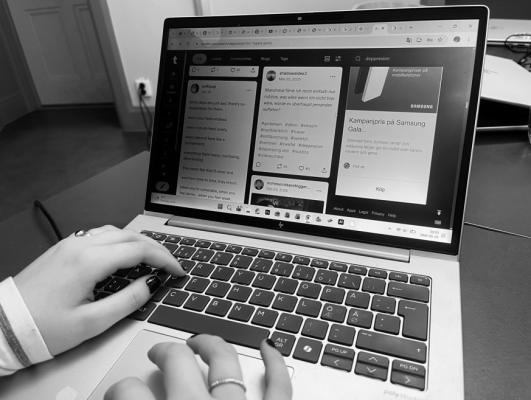
One example from the early 2000: nds is the site Tumblr. Tumblr is a website where you can reblog and post texts, GIFs, videos and pictures. On this site, which can seem innocent enough, a lot of content is about depression, self-harm and suicide is shared. Out of 3360 randomly selected posts, 82% of them contained content related to those three subjects.
Being on the internet as a young person this can be a very scary experience to scroll through if you suddenly come across this dark content. Especially if you are mentally unwell already, or just insecure, which a lot of people are in their teens. You might start to feel like these sorts of communities ´s are the only options even though they’re not good for you. It´s easy to forget that you are talking to other depressed young adults, teens and sometimes children, and not health care professionals.
The school counsellor Eranthi Hjortsberg at Anna Whitlocks gymnasium agreed with me when we spoke about this. She believes that with children being on the internet at a younger age than ever before, this kind of behaviour will only get worse. It’s an evil spiral that young impressionable children get fed with content about what they should have or not have, how they should feel, what they should do and so on until it really starts to get to them in ways they might not even notice themselves. Then one day they might stumble upon one of these text chains that might change them forever and make them do really bad things to themselves.
So, maybe humans do not really desire sadness itself, but what comes with it. Feeling like a good person and finding a community online. That the sadness becomes a part of your identity instead of something you want to heal from. So even though the internet can be a wonderful place to seek comfort it can also be one of the worst. It gives the suffering a meaning and it worsens the already existing desire within us.
References: (1) Friedrich Nietzsches "On the Genealogy of Morality", (2) Friedrich Nietzsches "Beyond good and evil" , (3) BLUE IS THE NEW BLACK: HOW POPULAR CULTURE IS ROMANTICIZING MENTAL ILLNESS - Emily Rose Dunn (2017), (4) "I Saw It In A Movie": Film Representations of the Mentally Ill Community & its GIF Transmediation onto Tumblr - Isabella McCloskey (2020)
Writers
Photo
As contributors to Mobile Stories, we adhere to its editorial guidelines. This involves verifying our sources, ensuring we don't violate any copyrights, and following the Young Reporter's Code of Ethics. Find out more about Mobile Stories. Read more about the Young Reporter's Code of Ethics.
 07 Sep |
 10 Jun Pupil |
 01 Jun Pupil |
 01 Jun Pupil |
 01 Jun Pupil |
 01 Jun Pupil |
 01 Jun Pupil |
 01 Jun Pupil |
 01 Jun Pupil |
 31 May Pupil |
 31 May Pupil |
|
31 May Pupil |
 31 May Pupil |
 31 May Pupil |
 31 May Pupil |
 31 May Pupil |
 31 May Pupil |
 31 May Pupil |
 31 May Pupil |
 28 May Pupil |
|
19 May Pupil |
|
19 May Pupil |
 19 May Pupil |
 19 May Pupil |
 19 May Pupil |
 19 May Pupil |
 19 May Pupil |
 19 May Pupil |
 08 May Pupil |
 08 May Pupil |
 18 Apr Pupil |
|
07 Sep Pupil |
|
10 Jun Pupil |
|
01 Jun Pupil |
|
01 Jun Pupil |
|
01 Jun Pupil |
 01 Jun |
 01 Jun |
 01 Jun |
 31 May |
 22 May |
|
31 May Pupil |
|
31 May Pupil |
|
31 May Pupil |
|
31 May Pupil |
|
28 May Pupil |
|
19 May Pupil |
|
19 May Pupil |
|
19 May Pupil |
 |
 |